
(The following is a press release from John J. Pershing VA Medical Center.)
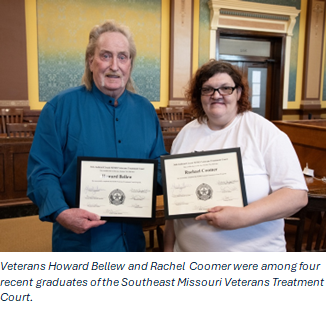
Poplar Bluff, MO. – As he stood in front of a crowded Butler County, Missouri, courtroom in early October, 70-year-old Marine Corps Veteran Howard Bellew felt a sense of accomplishment and hope. On this day, he and three others were graduating from the Southeast Missouri Veterans Treatment Court program.
The treatment court, the first multi-jurisdictional, rural Veterans treatment court in the nation, is in its 15th year pairing eligible, justice-involved Veterans with interventional services through the John J. Pershing VA Medical Center’s Veteran Justice Outreach Program (VJO).
“Veterans court gives high-risk, high need Veterans an option of going through structured treatment so they don’t go to prison,” explained Gary Helle, Veteran Justice Outreach coordinator at the medical center.
“We really try to wrap them with a comprehensive program that covers almost everything,” Helle said. “They get a one stop shop where we’re covering everything from homelessness to primary care to specialty care, mental health to substance use disorder, vocational … everything. The court doesn’t mandate a certain treatment, but they look for clinical recommendations.”
Helle finds those who qualify through a network he’s built of regional law enforcement officers, jail and court staff, and others. It’s a tireless effort, he said, to keep those connections and ensure Veterans are represented.
“The Veterans I work with tend to have more needs than other Veterans, and the vast majority going to Veterans court are from substance use disorder,” he said. “Many times, PTSD is connected with it, sometimes from family trauma, sometimes from military trauma, often from both.”
The treatment court program features five phases spread over the course of 15 months, explained Lesley Lynn, 36th Judicial Circuit Southeast Missouri Veterans Treatment Court commissioner. Veterans participate in group sessions and treatment at the VA medical center, and they must appear in court periodically.
“The point of the treatment court is to monitor their progress, to make sure they are working in treatment, and to make sure they’re showing up,” said Lynn. “Essentially, all their treatment is through VA.”
Veterans in the program have a support team of VA staff, from peer support specialists to mentors and others. “We work as a team to provide the best delivery to those Veterans,” Helle said.
Unlike in a traditional treatment court, where someone is there as an offender, in a Veterans treatment court, “you are going as a Veteran without the stigma of being an offender,” Helle explained. “When you go to PTSD group, you’re just there as a Veteran. Nobody knows you’re from Veterans court.”
Plus, before they graduate from the program, Helle said, the team ensures each Veteran is connected with family, community, financial and even cultural resources.
Bellew, a resident of Cape Girardeau County, said he entered the program after a DWI, his third, in the spring of 2025. At the time, he said, he was a “financial and mental wreck, and I drank to escape.”
While incarcerated in the Cape Girardeau County Jail, Bellew recalled, Helle paid him a visit and offered an olive branch through the VJO program. “He told me I could either spend four years in prison or go through this program, and this has helped me turn my life around,” Bellew said.
Many people in similar situations see treatment programs as a burden setting them up for failure, Bellew said, “but I looked at it like ‘hey, it’s a challenge.’ I knew it was going to be good for me, and I was willing to do something different with my life. It’s been remarkable.”
Army Veteran Rachel Coomer, 42, of Scott City, said she got involved in the program “because I had two drug charges. I ended up doing 92 days in jail, got out, then went back in on a violation.”
When she began treatment, Coomer said, “I didn’t want to do it … I was just doing it to get out of prison.”
With support from VA, she said, the program “has changed my life all around. It’s given me a new direction and stability.”
It’s also strengthened her family bond. “I’ve renewed my relationship with my mom, and my daughter says she’s proud of me. That’s everything I ever wanted … to make my daughter proud,” Coomer said.
Likewise, Bellew said, “It’s absolutely given me a new lease on life, and it’s opened more doors than you can imagine.”
As she stood in front of the courtroom, Coomer expressed her gratefulness, saying “Thank you for not giving up on me” and encouraging those still in the program to keep fighting. “Keep going … it’s so worth it,” she said.
Today, Coomer said, she is “looking forward to a future I never really thought of before.”
Also addressing the court, Bellew said confidently, “You can’t teach an old dog new tricks, but this guy here, this old man learned a lot of new things about how to change his life.”
Now sober for 18 months, Bellew said, “It’s good to look in the mirror and say, ‘hey, you’re going to be OK.’”
For more information about John J. Pershing VA Medical Center’s Veteran Justice Outreach Program or other programs and services, call 573-686-4151 or visit https://www.va.gov/poplar-bluff-health-care/ and https://www.va.gov/poplar-bluff-health-care/programs/veterans-justice-outreach-program/.